Merchant Services Near Me: How to Find a Processor That Actually Picks Up the Phone (2026)

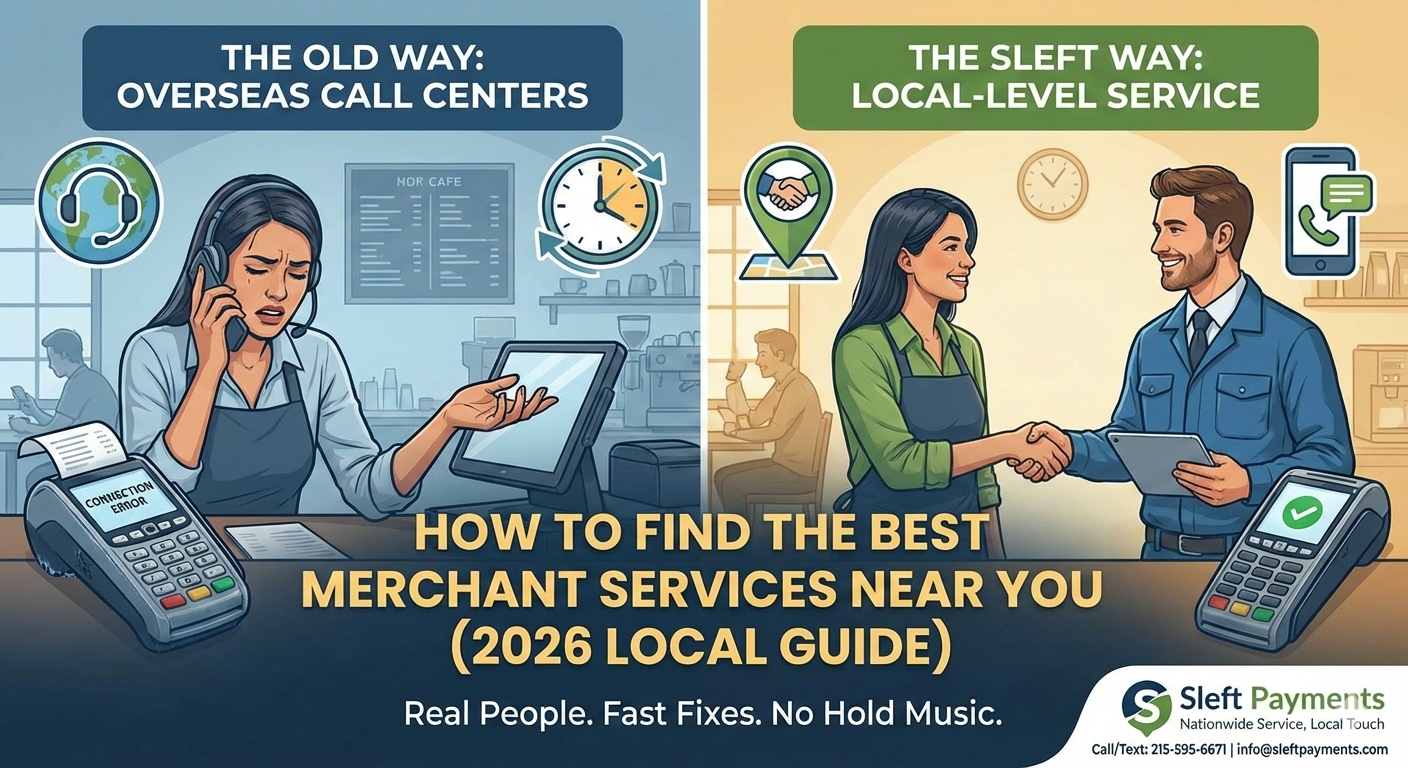
Merchant Services Near Me: How to Find a Processor That Actually Picks Up the Phone
Every month, 12,000 business owners Google "merchant services near me." Most of them end up on lead-generation websites that collect their phone number and sell it to 5-10 sales reps who call nonstop for the next two weeks.
That is not what you need.
What you need is a payment processor who answers the phone when your terminal dies during the dinner rush. Someone who can explain your statement in plain English. Someone who won't lock you into a 3-year contract with a $500 cancellation fee.
I am Grant Denmark, founder of Sleft Payments. I have been in this industry long enough to know that most of what shows up when you search "merchant services near me" is designed to capture your information, not to help you. This guide is different. I am going to break down exactly how merchant services work, what they should cost, and how to find a provider worth signing with, whether they are local to your city or not.
What "Merchant Services" Actually Means
Before you start comparing providers, you need to understand what you are buying. "Merchant services" is a catch-all term that covers:
Payment processing is the core service. Every time a customer swipes, taps, or enters a card number, a chain of transactions happens between your terminal, the card network (Visa, Mastercard), the customer's bank, and your bank. Your processor facilitates all of this and takes a fee.
A merchant account is a special bank account that holds your card sale proceeds before they settle into your regular business account. Not every provider gives you a dedicated merchant account (more on that below).
Hardware and software includes terminals, card readers, POS systems, and payment gateways for online sales.
Support and service covers installation, troubleshooting, statement review, rate negotiation, and compliance help.
When you search "merchant services near me," you are really looking for a company that bundles all of this together and supports you when something goes wrong.
The Three Types of Providers (And Why It Matters)
Not all merchant service providers are built the same. Understanding the difference saves you thousands of dollars and a lot of headaches.
1. Payment Aggregators (Square, Stripe, PayPal)
Aggregators pool all their merchants under one master account. You do not get your own merchant account. Setup takes minutes.
Pros:
- Instant approval, no underwriting
- Simple flat-rate pricing (2.6% + $0.10 per tap with Square)
- Good for very small businesses under $5,000/month
Cons:
- Fund holds and freezes are common. Aggregators use automated risk algorithms. If your sales spike, you get flagged, and your money gets held for weeks or months with no human to call. We have helped dozens of merchants recover frozen funds from Stripe and Shopify.
- Flat-rate pricing gets expensive fast. At $15,000/month in card sales, you are overpaying by $150-300/month compared to interchange-plus pricing.
- Support is email-only or chatbot. No phone. No human.
Best for: Side hustles, farmers market vendors, businesses under $5K/month.
2. Independent Sales Organizations (ISOs)
ISOs are the companies most people think of when they search "merchant services near me." They are authorized resellers for one or more payment processors. They set up your merchant account, install your equipment, and handle your ongoing support.
Pros:
- Dedicated merchant account (your money, your account)
- Interchange-plus pricing available (the lowest-cost model)
- Personal support from a real human
- Can negotiate rates based on your volume
Cons:
- Quality varies wildly. Some ISOs are excellent. Others use predatory contracts and hidden fees.
- You need to vet them carefully (use the checklist below)
Best for: Established businesses doing $5K+/month who want lower rates and personal support. This is where most businesses should land.
3. Banks
Many business owners assume their bank is the best place for merchant services. It feels safe. It is usually not the best deal.
Pros:
- One relationship for banking and processing
- Familiar brand
Cons:
- Banks typically resell processing through a third-party ISO and add their own markup
- Higher rates than going direct to an ISO
- Support goes through the bank's general customer service, not a payments specialist
- Less flexibility on pricing and contracts
Best for: Businesses that prioritize simplicity over savings and do not want to shop around.
Quick Comparison
| Aggregator (Square) | ISO (like Sleft) | Bank | |
|---|---|---|---|
| Own merchant account | No | Yes | Yes |
| Pricing model | Flat rate (2.6%) | Interchange-plus | Tiered or flat |
| Effective rate at $20K/mo | ~2.7% | ~1.8-2.2% | ~2.5-3.0% |
| Monthly savings vs Square | Baseline | $100-180/mo | $0-40/mo |
| Fund freeze risk | High | Very low | Low |
| Support | Email/chat | Direct phone/text | Branch or call center |
| Contract | Month-to-month | Month-to-month (good ISOs) | Often 1-3 years |
| Setup | Self-serve | White-glove install | Varies |
What Merchant Services Should Actually Cost in 2026
This is where most business owners get ripped off. They do not know what a fair rate looks like, so they accept whatever the first rep quotes them.
Here are real numbers based on actual merchant statements we have reviewed:
In-Person Businesses (Restaurants, Retail, Salons)
| Monthly Volume | Fair Effective Rate | You Should Pay | Square Would Charge |
|---|---|---|---|
| $10,000 | 2.0-2.4% | $200-240/mo | $270/mo |
| $25,000 | 1.8-2.2% | $450-550/mo | $675/mo |
| $50,000 | 1.7-2.0% | $850-1,000/mo | $1,350/mo |
| $100,000 | 1.5-1.8% | $1,500-1,800/mo | $2,700/mo |
E-Commerce and Keyed-In Transactions
Online and phone transactions cost more because fraud risk is higher:
| Monthly Volume | Fair Effective Rate | You Should Pay |
|---|---|---|
| $10,000 | 2.4-2.8% | $240-280/mo |
| $25,000 | 2.2-2.6% | $550-650/mo |
| $50,000 | 2.0-2.4% | $1,000-1,200/mo |
If you are paying more than 3% on in-person transactions or more than 3.5% on e-commerce, you are overpaying. Use our free savings calculator to see your actual number in 30 seconds.
Fees to Watch For
Beyond the processing rate, watch for these line items on your statement:
- Monthly minimum: $25 is standard. Above $50 is a red flag.
- PCI compliance fee: $0-15/month is normal. $30+ is inflated.
- Statement fee: $5-10 is standard. $15+ is padding.
- Batch fee: $0.10-0.25 per batch is normal. $0.50+ is excessive.
- Annual fee: Should not exist with a good processor.
- Equipment lease: Never lease a terminal. Buy it outright for $200-600 or get one included with your account.
Full breakdown of every processing fee and what is negotiable
How to Evaluate a Merchant Services Provider (The 10-Point Checklist)
Whether they are local, regional, or nationwide, run every provider through this checklist:
1. Can You Call or Text a Real Person?
Ask for a direct phone number. Not a 1-800 line. Not a ticketing system. A real phone number for a real human who knows your account. If they cannot provide this before you sign, they will not provide it after.
2. Will They Do a Free Statement Analysis?
Any legitimate provider will review your current statement for free and show you exactly where you are overpaying. If they quote you a rate without looking at your statement first, they are guessing, and that guess is designed to benefit them.
3. Is the Pricing Interchange-Plus?
Interchange-plus is the most transparent pricing model. You see the exact interchange rate (set by Visa/Mastercard) plus a fixed markup from your processor. Full explanation of interchange-plus vs flat-rate vs tiered pricing
Avoid "tiered" pricing (qualified, mid-qualified, non-qualified). It is designed to hide the true cost.
4. Is It Month-to-Month?
Good processors offer month-to-month agreements. If someone wants to lock you into a multi-year contract with a $300-500 early termination fee, walk away. They are banking on the penalty, not on keeping you happy.
5. Do They Install Equipment In Person?
A provider who shows up at your business, installs the terminal, and trains your staff is invested in your success. A provider who ships you a box with a setup guide is not.
6. What Happens When the Terminal Goes Down?
Ask specifically: "If my terminal stops working at 6pm on a Saturday, what do I do?" The answer should involve a direct phone number and same-day resolution. If the answer involves email or "next business day," keep looking.
7. Can They Provide References?
Ask for 2-3 references from businesses similar to yours. Call them. Ask about support response times, billing accuracy, and whether they would sign up again.
8. Do They Offer a Cash Discount or Dual Pricing Program?
If you want to eliminate processing fees entirely, ask about cash discount programs. These programs are legal in most states and pass the processing cost to card-paying customers as a small service fee. Done right, your processing cost goes to zero.
9. What Is Their Chargeback Policy?
Chargebacks happen. Ask how they help you dispute them and whether there is a per-chargeback fee. Good providers help you fight chargebacks. Bad ones just pass the cost along.
10. Will They Put the Rate in Writing?
If a rep quotes you a rate verbally but the contract says something different, the contract wins. Get everything in writing before you sign.
Red Flags That Should Make You Walk Away
- Non-cancellable equipment leases. A 48-month lease at $99/month for a terminal worth $300 is a $4,752 scam. This is the single most common ripoff in the industry. Always buy equipment outright.
- "Free" terminals tied to long contracts. If the terminal is free but you are locked into 3 years of processing, it is not free.
- Tiered pricing with "qualified" rates. This pricing model is designed to quote you a low rate and then downgrade most of your transactions to a higher tier.
- Same-day pressure. "This rate expires today" is a lie. Rates do not expire. A processor who pressures you to sign immediately is hiding something.
- No local references. If they cannot connect you with a single happy customer in your area, they do not have any.
- Vague answers about fees. If you ask "what are ALL the fees I will pay?" and the answer is anything other than a clear, itemized list, move on.
Finding Merchant Services by Location
If you are looking for payment processing in a specific area, we have put together local guides:
Florida:
- Best Credit Card Processor in Florida
- Payment Processing in Miami
- Payment Processing in Fort Lauderdale and Palm Beach
- Starting a Business in Florida? Payment Mistakes to Avoid
Major Cities:
By Industry:
How Sleft Handles Merchant Services Differently
I started Sleft because I saw the same problems over and over: hidden fees, terrible support, and contracts designed to trap business owners. Here is what we do differently.
You get my direct phone number. Not a call center. Not a chatbot. My phone number. Call or text anytime. (813) 534-0522.
We come to you. Equipment installation, staff training, and setup happen at your business. Takes about an hour. Zero downtime.
Interchange-plus pricing only. We do not use tiered pricing. You see exactly what Visa and Mastercard charge and exactly what our markup is. No surprises on your statement.
Month-to-month. Always. No contracts. No termination fees. If we are not saving you money and providing great service, you should be free to leave. We keep clients by earning it, not by trapping them.
Cash discount option. Want to pay zero processing fees? We set up a fully compliant cash discount program that passes the cost to card-paying customers. Most of our merchants choose this option.
Free statement analysis. Send us your current statement and we will show you exactly where you are overpaying, no commitment required. Email it to grant@sleftpayments.com or upload it here.
Frequently Asked Questions
How do I find a payment processor near me?
Search "[your city] merchant services" or "[your city] payment processing" on Google. Skip the first few results if they are lead-generation sites (they will ask for your phone number before showing you anything useful). Look for providers with a real person's name, a direct phone number, and Google reviews that mention customer service. Better yet, ask other local business owners who they use.
Is it better to use a local processor or Square?
For businesses processing under $5,000/month, Square's simplicity makes sense. Above that, a dedicated merchant account with interchange-plus pricing will save you $100-300+ per month. The bigger issue is support: when your terminal goes down on a busy night, Square offers email support. A good local or regional processor answers the phone. Full comparison of Square vs interchange-plus pricing
What is a fair rate for credit card processing in 2026?
For in-person transactions, a fair effective rate is 1.8-2.4% depending on your volume and average ticket. For e-commerce, 2.2-2.8% is reasonable. If you are paying above 3% for in-person or 3.5% for online, you are likely overpaying. The only way to know for sure is to have someone review your actual statement. Get a free statement review.
Can I switch processors without downtime?
Yes. A good processor will have your new equipment installed and tested before deactivating your old account. The switch itself takes about an hour and your customers will not notice a thing. Full guide to switching payment processors
What is a cash discount program?
A cash discount program lets you post card prices and offer a discount for cash payments. Effectively, card-paying customers cover the processing fee. This is legal in 48 states and eliminates your processing costs entirely. Complete guide to cash discount programs
How much does it cost to set up merchant services?
With a good provider, setup should cost little to nothing. Terminal hardware runs $200-600 if purchased outright (never lease). Many providers include a terminal at no cost when you sign up. Monthly fees (statement fee, PCI compliance) should total under $30. There should be no "setup fee" or "application fee" -- those are junk fees.
What is the difference between a merchant account and a payment aggregator?
A merchant account is your own dedicated account for processing card payments. A payment aggregator (Square, Stripe, PayPal) pools all merchants under one shared account. The key difference: with your own merchant account, your funds are less likely to be frozen, your rates are typically lower at higher volumes, and you have a dedicated support contact.
The Bottom Line
"Merchant services near me" is one of the most searched payment processing terms in the country. Most of the results are designed to capture your phone number and sell it.
Here is the simple truth: the best merchant services provider for your business is the one who answers the phone, shows you honest pricing, does not lock you into a contract, and helps you keep more of every dollar.
If that sounds like what you are looking for, let's talk.
Call or text: (813) 534-0522
Email: grant@sleftpayments.com
Free savings calculator: See how much you are overpaying
About the Author
Grant Denmark is the Founder and CEO of Sleft Payments. He helps small businesses across the country find honest payment processing with transparent pricing, no contracts, and support from a real person. Based in South Florida, serving businesses nationwide.